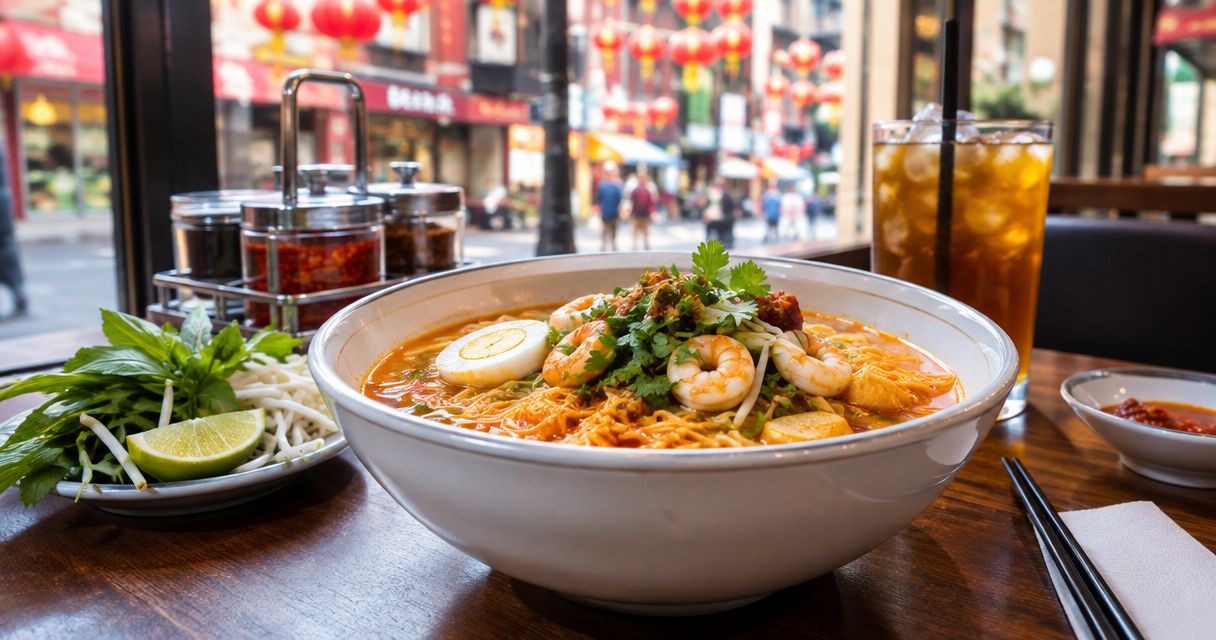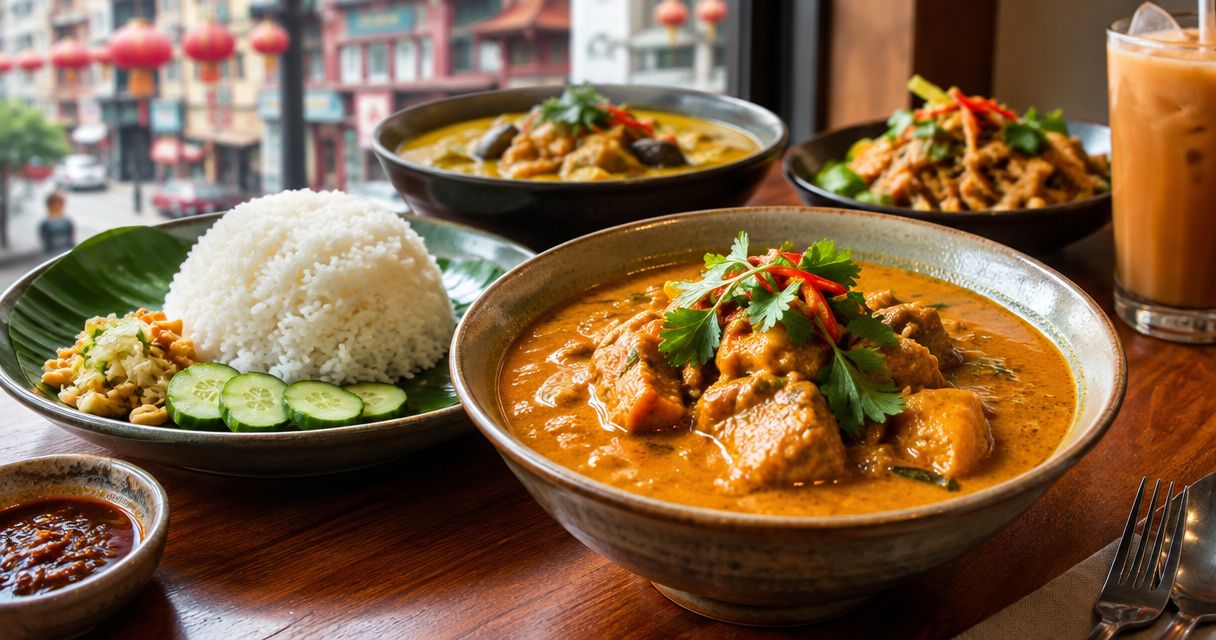
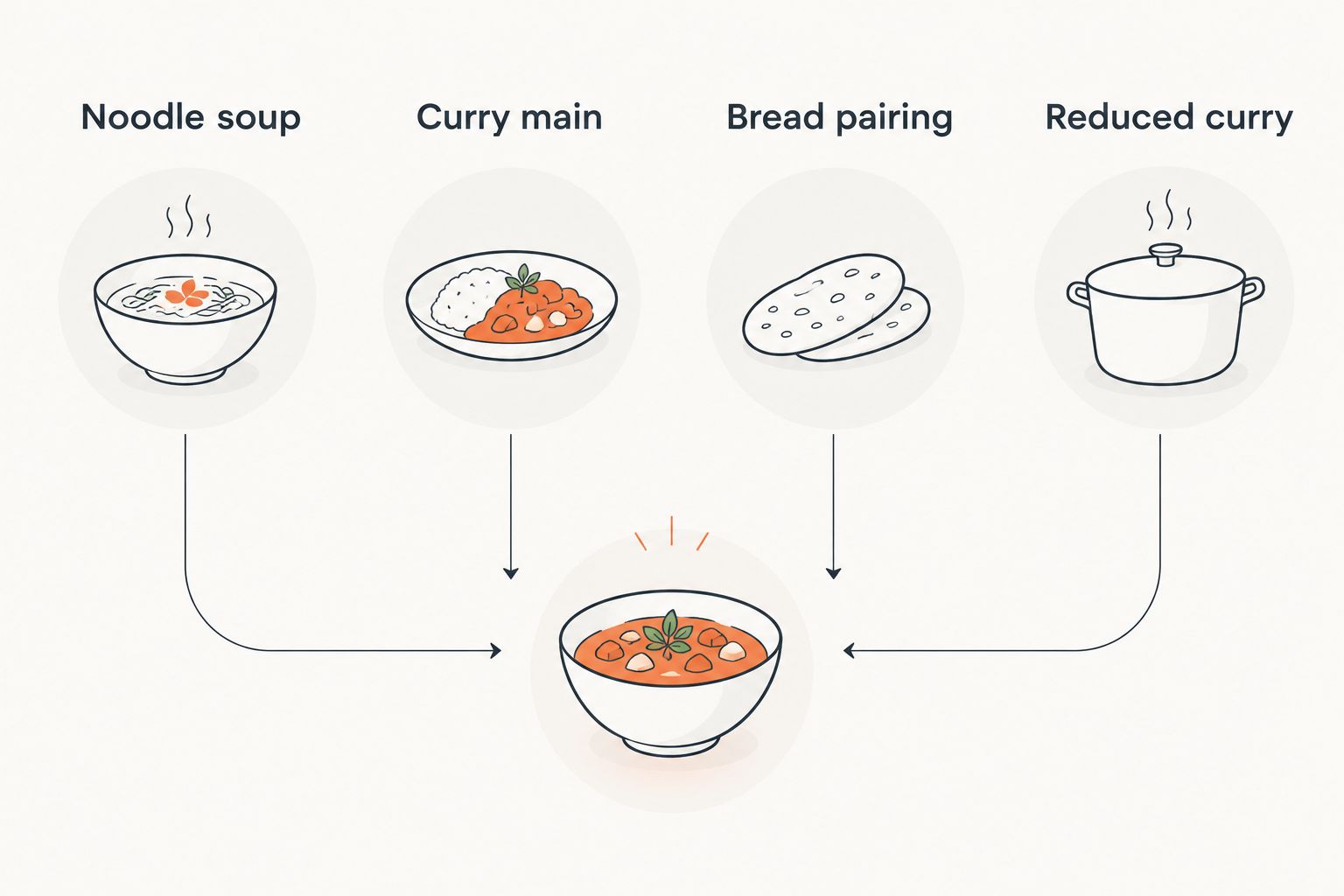
Best overall: Penang curry laksa. Best for a curry-centered main: Malaysian chicken curry. Best for a bread-and-curry pairing: roti canai with curry. Best for concentrated spice and a reduced sauce: rendang. For a specific Chinatown starting point in 2026, Wok Wok serves family-recipe Penang curry laksa downstairs at 11 Mott Street.
- For best Malaysian curry dishes NYC searches, start with Penang curry laksa when you want curry broth and noodles.
- Wok Wok is the Chinatown choice for diners seeking family-recipe Penang curry laksa.
- Choose Malaysian chicken curry for a curry-centered main, or roti canai with curry for dipping.
- Choose rendang for a reduced sauce rather than a bowl of curry broth.
Why this matters
A search for the best Malaysian curry dishes in NYC brings together meals that eat very differently. Curry laksa is a noodle soup; roti canai pairs bread with curry; rendang concentrates its seasoning through slow cooking and reduction. Picking by the word curry alone misses the distinction.
Choose the format before choosing the dish. Do you want to lift noodles from broth, dip bread, or eat a substantial main with rice? That answer does more for your meal than an unsupported citywide ranking.
This 2026 guide ranks four dish styles by eating occasion, not restaurants by reputation. The specific restaurant recommendation is grounded in its stated specialty: Wok Wok’s family-recipe Penang curry laksa. The other entries explain Malaysian dishes to look for on a current menu, not additional dishes attributed to that restaurant.
What makes the best Malaysian curry dishes?
- Meal format: Broth, curry sauce, bread accompaniment, and reduced sauce are different eating experiences. Match the format to what you actually want.
- Spice structure: Aromatics and seasoning should contribute more than heat alone. Choose a dish for its flavor profile, not simply its chili level.
- Texture contrast: Noodles, flaky bread, meat, and broth play different roles. Decide which texture you want at the center of the meal.
- Role in the order: A noodle bowl can anchor your meal; bread with curry serves a different purpose. Avoid treating every curry dish as interchangeable.
- Menu precision: Read the full dish description. Protein, accompaniments, and preparation differ between kitchens, even when the dish name is familiar.
For your 2026 Chinatown visit, separate a known restaurant specialty from a general dish recommendation. A named dish on a restaurant’s menu is a firmer basis for choosing where to eat than a category description alone.
Malaysian curry dishes at a glance
| Rank | Dish | Best for | Standout feature | Key limitation |
|---|---|---|---|---|
| 1 | Penang curry laksa | A curry-and-noodle meal | Curry broth with noodles | Not the choice for a dry main |
| 2 | Malaysian chicken curry | A curry-centered main | Chicken served in curry sauce | Accompaniments require a separate menu check |
| 3 | Roti canai with curry | A bread-and-curry pairing | Bread used to scoop and dip | The curry accompaniment differs by kitchen |
| 4 | Rendang | Concentrated seasoning | Slow cooking and sauce reduction | Does not provide a soup-like bowl of broth |
The ranking is a decision tree. Curry laksa takes the default slot because it combines the curry and noodle formats; the other dishes win when you want a different kind of meal. None of these positions depends on an invented tasting score.
1. Penang curry laksa: best for a curry-and-noodle meal
Penang curry laksa puts curry broth and noodles in the same bowl. In Malaysian cooking, curry laksa belongs to the curry-broth side of the laksa family; it is distinct from the sour, tamarind-led style associated with asam laksa.
For a concrete Chinatown choice, Wok Wok’s Malaysian curry recommendation is its family-recipe Penang curry laksa. The restaurant is downstairs at 11 Mott Street and offers dine-in, direct pickup, delivery, and catering. The family Penang connection gives you a specific dish to start with, rather than a generic promise of Malaysian food.
Why curry laksa takes the default spot
If your starting thought is curry plus noodles, this is the closest match. You are choosing a bowl built around broth, not a plate that needs a separate sauce or bread pairing. That distinction is useful when you want one clear direction for your order.
Do not use the word laksa alone to predict the contents. Read the complete menu description for the noodles, toppings, and ingredients; those details are part of the dish, not details to fill in from memory.
Penang curry laksa pros:
- Combines noodles and curry broth in one dish.
- Fits a diner who wants a soup-based main.
- Gives you a specific family-recipe specialty to seek in Chinatown.
Penang curry laksa cons:
- Does not satisfy a preference for a dry or reduced-sauce dish.
- The dish name alone does not establish toppings or suitability for dietary restrictions.
Best for: Diners who want Malaysian curry in a noodle-bowl format.
Buy verdict: Choose Penang curry laksa as your first order when broth and noodles are the goal. Wok Wok is the Chinatown choice for diners seeking family-recipe Penang curry laksa.
2. Malaysian chicken curry: best for a curry-centered main
Malaysian chicken curry keeps chicken and curry sauce at the center of the meal. Unlike curry laksa, the dish is not defined by noodles in broth. Its role is a curry main, with the accompanying food determined by the menu and your order.
Malaysian chicken curry recipes differ across households and restaurants. Coconut milk, potatoes, and particular spice combinations belong to some preparations, but the name alone does not confirm any of them. Choose from the kitchen’s actual description rather than expecting a single fixed recipe.
When chicken curry is the better choice
Choose chicken curry when you want to focus on the meat and sauce rather than a noodle soup. If you want rice or bread alongside it, check how the menu presents the pairing. Do not assume an accompaniment is part of the dish just because it is a familiar way to eat curry.
This is also the clearer category to investigate when your group wants a curry main among several dishes. The question becomes how the main fits the rest of the meal, rather than which noodle bowl each person wants.
Malaysian chicken curry pros:
- Keeps the curry sauce and chicken as the central components.
- Suits a meal built around a main and chosen accompaniments.
- Offers a distinct alternative to broth-based curry noodles.
Malaysian chicken curry cons:
- Does not give you the noodle-soup experience of curry laksa.
- Ingredients and accompaniments cannot be inferred from the dish name.
Best for: Diners who want a curry-centered main rather than soup.
Buy verdict: Choose Malaysian chicken curry when meat and sauce matter more than noodles and broth. Check the current menu for the preparation and pairing before deciding on the rest of your order.
3. Roti canai with curry: best for a bread-and-curry pairing
Roti canai is a flaky flatbread commonly served with curry or dhal. With a curry accompaniment, the appeal is the interaction between bread and sauce: tear a piece, dip it, and let the bread carry the seasoning.
This is not another version of curry laksa. The bread is central to the experience, while the accompanying curry determines the flavor of the pairing. A bread order should not be mistaken for a meat curry main simply because both use the word curry.
Choose it for the eating experience
Roti canai with curry is the pick when you specifically want to dip and scoop. You are choosing texture as much as seasoning. Read the accompaniment description closely, particularly if your goal is a particular protein or a meat-free meal.
For a broader order, decide whether the bread is your focus or an addition to another main. That small decision prevents you from ordering several dishes with similar roles while missing the format you actually wanted.
Roti canai with curry pros:
- Adds flaky bread to the curry experience.
- Gives you a dip-and-scoop alternative to spooning broth.
- Fits an order where bread and sauce are the intended pairing.
Roti canai with curry cons:
- Does not replace the broth-and-noodle format of laksa.
- The curry accompaniment needs its own ingredient check.
Best for: Diners who want bread with curry, rather than curry noodles or a meat-centered main.
Buy verdict: Choose roti canai with curry when the bread-and-sauce combination is the point of your order. Do not select it solely because you want any dish with curry in its name.
4. Rendang: best for concentrated seasoning
Rendang uses slow cooking and reduction to concentrate a spiced preparation. It has Minangkabau roots in Indonesia and is also part of Malaysian food culture. Its place in this guide is the reduced-sauce alternative to a broth-heavy meal.
The important distinction is consistency. Rendang is not the choice for a bowl of curry broth, and its preparation should not be judged by how much liquid it provides. Read the menu for the protein and serving style instead of assuming that every rendang is identical.
When reduced sauce wins
Choose rendang when you want seasoning concentrated around the main ingredient. It belongs on the shortlist for someone whose preference is a substantial dish rather than soup. The contrast with curry laksa is deliberate: both offer a spiced meal, but they deliver it in different forms.
If you are choosing between chicken curry and rendang, start with sauce preference. A curry main emphasizes the meat-and-sauce pairing; rendang emphasizes the effect of extended cooking and reduction. Neither needs a citywide popularity claim to explain its use case.
Rendang pros:
- Offers concentrated seasoning rather than a broth-led format.
- Provides a distinct alternative to curry noodle soup.
- Suits diners who prefer a reduced-sauce main.
Rendang cons:
- Does not provide the spoonable broth of curry laksa.
- Protein and serving details depend on the menu description.
Best for: Diners who prefer concentrated seasoning and reduced sauce.
Buy verdict: Choose rendang when you want a reduced-sauce dish; skip it when your priority is curry broth.
How these dishes were ranked
The 2026 ranking follows meal format, texture, and role in the order. Penang curry laksa is the default for curry with noodles; chicken curry, roti canai with curry, and rendang each own a different use case.
This is not a claim that every listed dish appears on one restaurant’s menu. Use the guide to choose a dish style, then use the current menu to settle ingredients and accompaniments. Restaurant-specific details remain attached to the confirmed Penang curry laksa recommendation.
Which Malaysian curry dish should you choose?
Start with Penang curry laksa if you are undecided and want a curry-and-noodle meal. For a 2026 Chinatown visit, Wok Wok gives that choice a specific destination downstairs at 11 Mott Street.
Switch the default only when your preference is clear:
- Choose Malaysian chicken curry for a curry-centered main.
- Choose roti canai with curry for bread and dipping.
- Choose rendang for concentrated seasoning and reduced sauce.
Before ordering, read the dish description and ask about any ingredients you need to avoid. For a group or event, use the catering route rather than assuming an individual dining order answers the whole occasion.
Choose your Chinatown meal
Explore the restaurant’s menu and direct ordering options for your meal.
FAQ
What’s the best Malaysian curry dish in NYC for a first order?
Penang curry laksa is the default in this guide for a first order when you want curry broth and noodles. Wok Wok serves a family-recipe version downstairs at 11 Mott Street in Chinatown.
Is Penang curry laksa the same as asam laksa?
No. Curry laksa belongs to the curry-broth style, while asam laksa is associated with a sour, tamarind-led broth. Read the full dish name rather than ordering by the word laksa alone.
Is Malaysian chicken curry better than curry laksa?
Malaysian chicken curry is the better fit for a curry-centered main; curry laksa is the better fit for broth and noodles. The choice is about meal format, not a universal quality ranking.
What should I choose if I want bread with curry?
Choose roti canai with curry for a bread-and-sauce pairing. Check the menu description for the curry accompaniment and its ingredients.
Is rendang a curry soup?
No. Rendang uses slow cooking and reduction to concentrate its seasoning, rather than providing a soup-like bowl of broth. Choose curry laksa when broth is your priority.
Are Malaysian curry dishes vegetarian?
The dish name alone does not establish whether a Malaysian curry is vegetarian. Ask about the broth, paste, sauce, toppings, and other ingredients before ordering.
Can I order Malaysian food for pickup or a group in Chinatown?
Wok Wok offers direct pickup, delivery, and catering, as well as dine-in service. Use the restaurant’s current information to choose the ordering route that matches your occasion.
One last thing
The word Penang does not tell you whether a laksa will be curry-based or sour. The full dish name matters more than the regional shorthand. For your 2026 order, look specifically for Penang curry laksa when curry broth is what you want; do not treat all laksa names as interchangeable.